
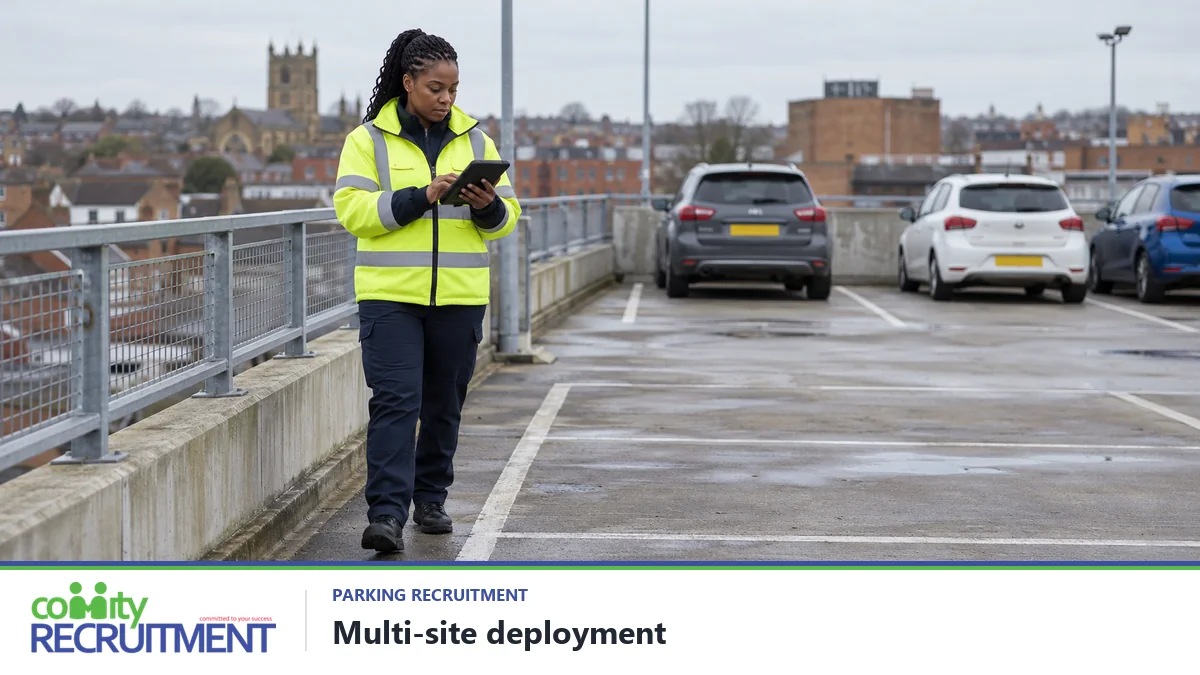
Managing parking enforcement across several locations means coordinating officers, working hours and site requirements. Clients need to know who is covering each assignment, how attendance will be monitored and what happens when staffing needs change.
At Comity Recruitment, we help parking contractors and site operators plan and resource their deployment requirements. Our support covers temporary, permanent and temporary-to-permanent recruitment, from individual shifts to ongoing multi-site assignments.
Our role is not simply to identify available personnel. We work with clients to agree the staffing requirement, coordinate start arrangements and establish how deployment information will be reported and reviewed.
Where deployment reporting forms part of the assignment, we agree which activities Comity will manage and which remain with the client’s operational team.
Agreeing the deployment brief
An effective deployment brief connects recruitment to the service you need to deliver.
Before arranging cover, we work with you to establish:
- Locations and duties: the sites, patrol areas and responsibilities assigned to each officer.
- Working patterns: dates, shift times, paid hours, breaks and assignment duration.
- Staffing requirements: the number of officers, relevant experience and any driving or vehicle requirements.
- Site arrangements: reporting points, induction, equipment, access, supervision and operational contacts.
- Deployment KPIs: how coverage will be measured, reported and reviewed.
This helps us identify suitable personnel, confirm availability against the actual working pattern and coordinate the agreed start arrangements with your team.
It also allows practical issues to be addressed before deployment. A mobile schedule needs sufficient time to travel between locations, while a static assignment needs clear arrangements for breaks, relief and handovers.
The staffing plan should reflect what can realistically be delivered—not simply the total number of officers or hours available.
Two common delivery models
A multi-site operation may combine static assignments and mobile patrols. Each requires a staffing plan that reflects how the work is delivered.
Static coverage
Continuous static attendance at an agreed location.
Agree staffing levels, working hours and arrangements for breaks, relief and handovers.
Coverage measure: confirmed deployment hours against the agreed hours required.
Mobile patrols
Visits across several locations within an agreed patrol schedule.
Allow sufficient travel time between locations and agree the required visits and patrol windows.
Coverage measure: qualifying visits completed against visits required at each location.
Weekday, weekend, evening and night shifts can apply to either model. Planned absence, event dates and seasonal demand may also require additional personnel within the same deployment plan.
For example, a client may need regular static cover at one location, mobile visits across several smaller sites and additional personnel during busy weekends.
Each requirement should have its own agreed staffing level and coverage measure. A completed mobile patrol should not be treated as equivalent to continuous static attendance.
Agreeing attendance and patrol reporting
Attendance reporting gives clients a clearer view of whether agreed staffing commitments have been delivered.
We agree the reporting method, responsible contacts and review frequency for each relevant assignment. Depending on the operation, this may include shift start and finish confirmations, site arrival and departure reports, completed mobile-patrol records and client-approved timesheets.
The arrangements should also identify how officers report lateness, absence, access problems or interrupted duties.
We review the information received against the agreed shifts or visit schedule and follow up missing records or discrepancies with the officer and client contact.
A missing report needs checking before it is treated as a missed shift. Equally, an officer’s start confirmation does not establish that every required patrol or duty has been completed.
Where information is incomplete, the report should distinguish confirmed delivery, confirmed shortfalls and records awaiting verification. This avoids presenting an unresolved reporting issue as a proven failure—or assuming that unverified coverage has been delivered.
Attendance reporting should sit alongside the agreed welfare and lone-working arrangements, not replace them.
Where a coverage gap is identified, we establish the affected assignment, communicate the position and discuss the staffing action required.
Measuring deployment KPIs
Deployment key performance indicators should give both parties a consistent way to assess staffing delivery.
The measures selected will depend on the assignment:
| Measure | What to assess |
|---|---|
| Hours-based coverage | Confirmed deployment hours delivered against agreed hours required. Agree the treatment of travel, breaks, handovers and interrupted duties. |
| Visit-based coverage | Qualifying visits completed against visits required at each location and within the agreed patrol windows. |
For an hours-based measure:
Deployment coverage (%) = confirmed deployment hours delivered ÷ agreed deployment hours required × 100
Before using that calculation, agree how travel, breaks, handovers and interrupted duties are treated. Paid hours, attendance hours and time available for enforcement may be measured differently.
Where records remain unresolved, identify the coverage figure as provisional rather than presenting it as a completed assessment.
For visit-based assignments, assess the qualifying visits completed against the visits required at each location and within the agreed patrol windows.
A visit to one site should not automatically compensate for a missed visit elsewhere. Similarly, a strong overall hours total may conceal an uncovered shift at a particular location.
Headline figures should therefore be supported by site and shift details, so managers can see where a shortfall occurred and what action it requires.
For local authority civil parking enforcement in England, the Department for Transport’s statutory guidance states that raising revenue should not be an enforcement objective and that authorities should not set targets for revenue or the number of Penalty Charge Notices issued.
The staffing measures discussed here concern agreed attendance, coverage and service requirements—not targets for issuing penalties.
Responding when staffing requirements change
Staffing requirements can change because of sickness, planned leave, a new site, extended operating hours or increased demand.
When a client’s requirement changes, we work through three practical steps.
1. Confirm the changed requirement
Establish which locations, shifts, duties and staffing levels are affected, including any immediate priorities.
A request for an additional weekend officer is different from a replacement for an already agreed shift. The change should be clear before recruitment or cover arrangements are revised.
2. Review suitable staffing options
Discuss additional or replacement personnel, their suitability and any induction, equipment or access arrangements needed.
For planned changes, early notice gives more time to coordinate recruitment and site preparation. For unexpected absence, clear contacts and escalation arrangements help establish the position and available options.
3. Confirm arrangements and remaining gaps
Communicate the personnel and start arrangements that have been secured, identify any remaining gap and update the staffing plan.
Requested cover, confirmed bookings and completed deployment are different stages. Clear communication helps the client understand the actual position.
Changes requested by the client should also be recorded separately from shortfalls against an existing commitment. This keeps reporting clear when the underlying requirement changes.
Using reporting to improve the staffing plan
Attendance and deployment records are most useful when they inform the next staffing decision.
They may reveal the same shift repeatedly becoming uncovered, a mobile schedule allowing insufficient travel time, an unresolved site-access issue or predictable increases in demand.
We can discuss whether these patterns call for regular temporary cover, dedicated weekend personnel, seasonal support or a longer-term appointment.
Where the issue concerns travel, access or reporting rather than headcount, adding another officer may not address the underlying problem.
The purpose of the review is to turn the information collected into a more workable deployment plan—not simply produce another attendance report.
For the broader decisions about overtime, staff retention, seasonal requirements and temporary-to-permanent recruitment, read our parking enforcement staffing and temporary-cover guide.
Discuss your deployment requirements
Whether you need a single shift covered, mobile patrol personnel, additional weekend officers or ongoing multi-site support, Comity Recruitment can discuss staffing arrangements around your operation.
Tell us the locations, duties, working pattern, proposed start date and deployment requirements. We will work with you to agree the recruitment brief, relevant attendance reporting and arrangements for changes to cover.
Explore our parking recruitment and deployment service or contact our team to discuss your requirements.
We don’t just recruit personnel—we help you meet your deployment commitments.
Discuss Your Deployment Requirements
Telephone: 020 3092 7378